
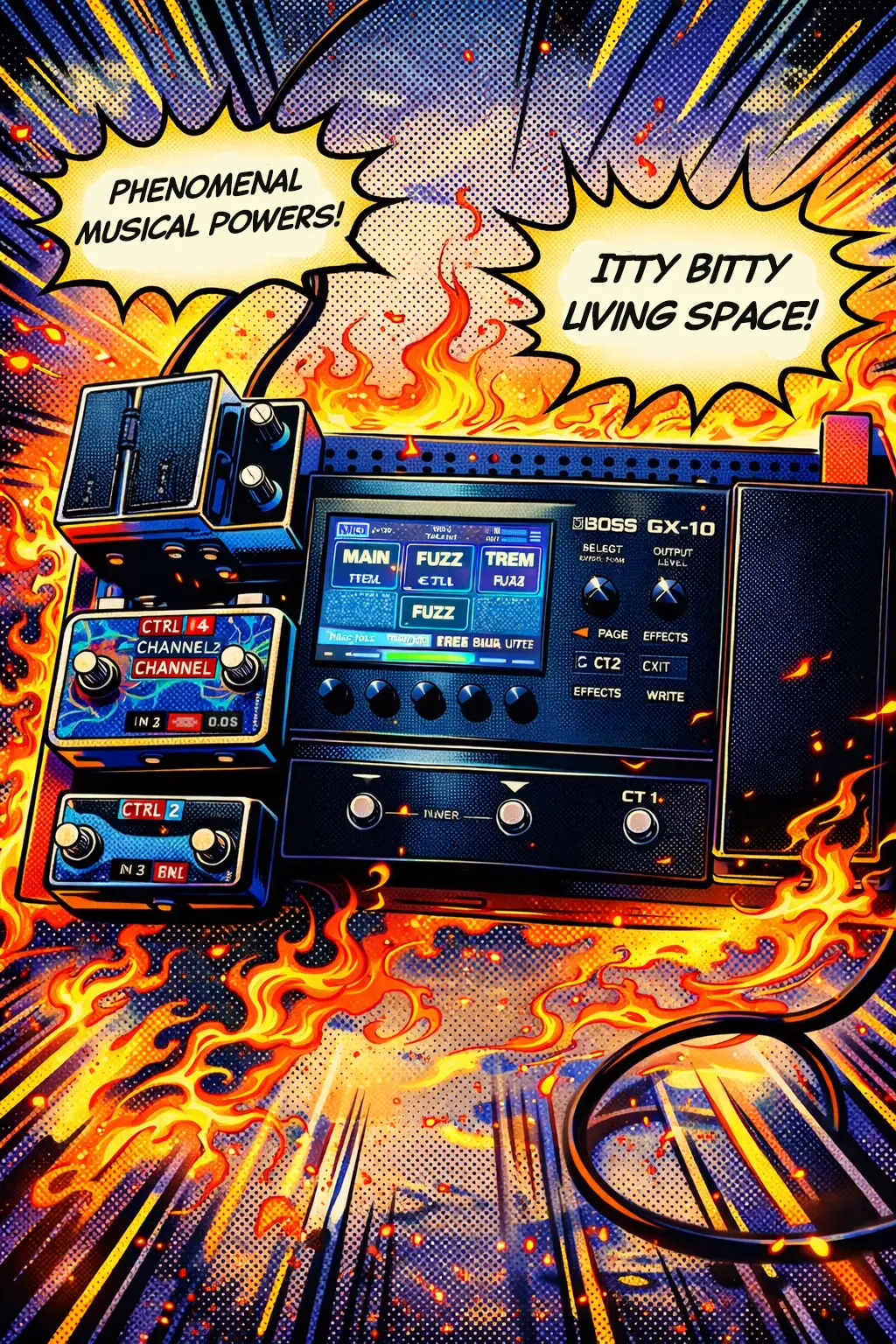

This week, we’re going to take a big step back and talk about rigs and ideas for how to design and build well integrated systems that work just the way you want them to.
First, my standard disclaimer of:
Your stuff is super cool too.
But I’ve gotten a number of inquires both direct and on some of the forums I frequent, over the what’s and why’s of my setup. So! Here we go!
Soapbox Inbound

Before you buy! Definitely, definitely lock down exactly what you’re looking for in a box in regards to features and form factor before you go diving in.
Purchase With Intent
The only other advice I’ve got?
Don’t go chasing the “Sounds Better Than Dragon”
EVERYTHING sounds pretty great these days, though certainly individual pairs of ears may and will have their own preferences.
But I can’t stress this enough.
Don’t fall down the rabbit hole of trying to find an empirical answer to “What sounds best”. Just about everything currently available today can be dialed in to sound pretty great.
The only wrong gear choice is:
- A piece of gear you never really learn how to use effectively
- A piece of gear you’ve dug deep into and tried your best, but just aren’t jiving with it
In the first case?
Slow down. Learn your tools. Then make up your mind.
In the second, don’t feel bad about moving on. Even if everybody else on your favorite forum(s) swears by a certain piece. If it’s not working for you? It’s not working for you.
Move on and find the thing that DOES work for you.
If you find yourself wheel spinning and overwhelmed? Feel free to drop a note in the Comments or just drop me a note directly via the Contact page.
Always happy to try and help someone find clarity and direction. It can be a lot a lot, at least at first.
</soapbox>
My Rig

I know, right? Kind of underwhelming.
But that’s the point.
NOTE: If I didn’t have a moderately more complicated use case, I’d just run the GX-10 as is and call it a day.
The Components:
- BOSS GX-10
- Saturnworks A/B Input/Output Pedal + FX Loop
- Saturnworks Double Switch (BOSS specs: Normally closed, momentary)
- BOSS XS-1 Poly Shifter pedal
- Temple Audio Solo pedal board.
- Temple Audio 2x Mod
- Temple Audio DI Mod Pro, Stereo
- Cioks SOL Power Supply
- A mess of patch cables and cable ties.
- Laney 1×12 FRFR (guitar amp)
- Ampeg SVT-3 Pro w/ Ampeg 4×10 (bass amp)
The Breakdown
The primary goal of this pedal board is pretty straight foward:
- Small. Light. Portable.
- Headphone support.
- Do as much as possible with as little as possible.
- Be able to juggle both a two guitar, or guitar and bass, gig with zero headaches, using one board.
- This means I need to be able to support 2 channels of audio with their own independent inputs and outputs, that are able to share the GX-10.
Here’s how I did it, in signal chain order:
Temple Audio 2X Mod

Simple enough. I need two separate input channels. So, I have two separate input channels.
BOSS XS-1

I’ll just come out and say it.
I don’t like using capos.
Is it irrational and dumb? Probably.
But when I’m in a pinch and need to eat an awkward transposition ASAP? I can just turn a dial and boom. The sound coming out the other end is in the right new key.
I also really like experimenting with the Octave Up and Down for different sorts of ‘guitar and pseudo bass’ and ’12-string/mandolinish’ sounds.
Saturnworks A/B Input/Output Pedal w/ FX Loop

Is that a mouthful? Sure is! But it’s also the ‘secret sauce’ that makes the whole thing work.
How?
I run Channel 1/one instrument into a dedicated input and out a dedicated output. I do the same with Channel 2/another instrument.
Toggling the switch lets me toggle between the two channels/instruments.
So I can, for example, run a guitar into Channel 1 and out to a Laney 1×12 FRFR. I can run a bass into Channel 2 and out to an Ampeg SVT-3 Pro and 4×10. And then I just hit the switch depending on what I’m playing.
The integrated FX loop is what ties the GX-10 in, and lets me send either channel/instrument through it without needing to repatch anything.
Config: Sending to the GX-10’s Input and Returning the GX-10’s Mono/L Output.
If I’m running two guitars and need both Channel Outputs to go to the same place, I just drop a little passive mixer at the end of the chain so I can run 2-in/1-out. EZPZ.
BOSS GX-10:

Quite simply, the beating heart and brains behind all of this. It’s job is to deliver modeled amps and cabs, a robust effects suite, and solid usability and control capabilities.
While also sounding fantastic.
Saturnworks Double Switch

Again, simple. Gives me Control 2 and Control 3 switches to expand my control assignment options.
It might be worth pointing out that this actually ended up being more ‘nice to have’ than mission critical, and I’ve got them assigned to quality-of-life things. Control 2 toggles me between Manual and Bank mode, Control 3 is my default ‘channel’ switcher if I’ve got a dual signal chain patch with independent channels.
Temple Audio Stereo DI Pro

Balanced active 2-channel DI that lets me feed whatever I’d like to. Whether that’s an FRFR, an amp, a PA, or FOH. Whatever.
Typically one channel goes to my guitar rig, the other goes to my bass rig. I toggle between channels using the Saturnworks A/B switch previously mentioned.
CIOKS SOL Power Supply

Can’t do much without power. This gives me 5 independent outs with selectable voltage and 660mA each.
Everything on the board is properly fed and happy.
Temple Audio 18″ Solo

This was my self-imposed constraint. I was going to make myself make the smallest Temple Audio option work.
Because that’s the whole scope of the board. Littlest.
End Result
Everything works as intended, and I was able to stick to my board size constraint goals. Couldn’t be happier with the results. I still love my big pedal boards and all my pedals. But, dude.
Dude.
It’s bananas the ground I can cover with this rig.
It is a magical time to be a musician.

Amp It Up
Just as a post-script, because ‘what do I do now?’ is a common follow up question. Here are my nexts.

My guitar rig is simple (seeing the running theme across all of this?). I run out of the pedal board directly into the Laney, and, that’s it.
There are MANY FRFR solutions out there, so why did I opt for the Laney?
Feature-wise, it does the FRFR thing but still sounds very combo-y.
It’s light (comparably).
It can sit horizontal or vertical depending.
And with its built in DI, I can feed anything I need to downstream.
It also sounds wonderful no matter what I throw at it, and is loud enough for me to fill the space I need to without extra re-enforcement.

Bass-wise, it can be more ‘it depends’. Which makes the SVT-3 great for me.
Outside of being a great clean pedal/effect platform, and the fact that we’ve been together for over 20 years now and she’s never let me down:
- If I just want effects (i.e. I’m using the Ampeg amp and cab as is)? I can either run directly into the main input, or, if I’m feeling especially clever with myself I can set up a 4CM using the 3’s built-in effects loop and the GX-10’s own effects loop and S/R block.
- If I want to use the GX-10’s amp models but use the SVT-3’s power amp and the 4×10 cab? I can run into the Power Amp In, disabling the cab in the GX-10’s amp/cab block.

