

Download the “OS Collection” Liveset

This Liveset is ONLY compatible with the BOSS GX-10 and GX-100 modelers.
For more specific information, including what to do if you have a different modeler: CLICK HERE

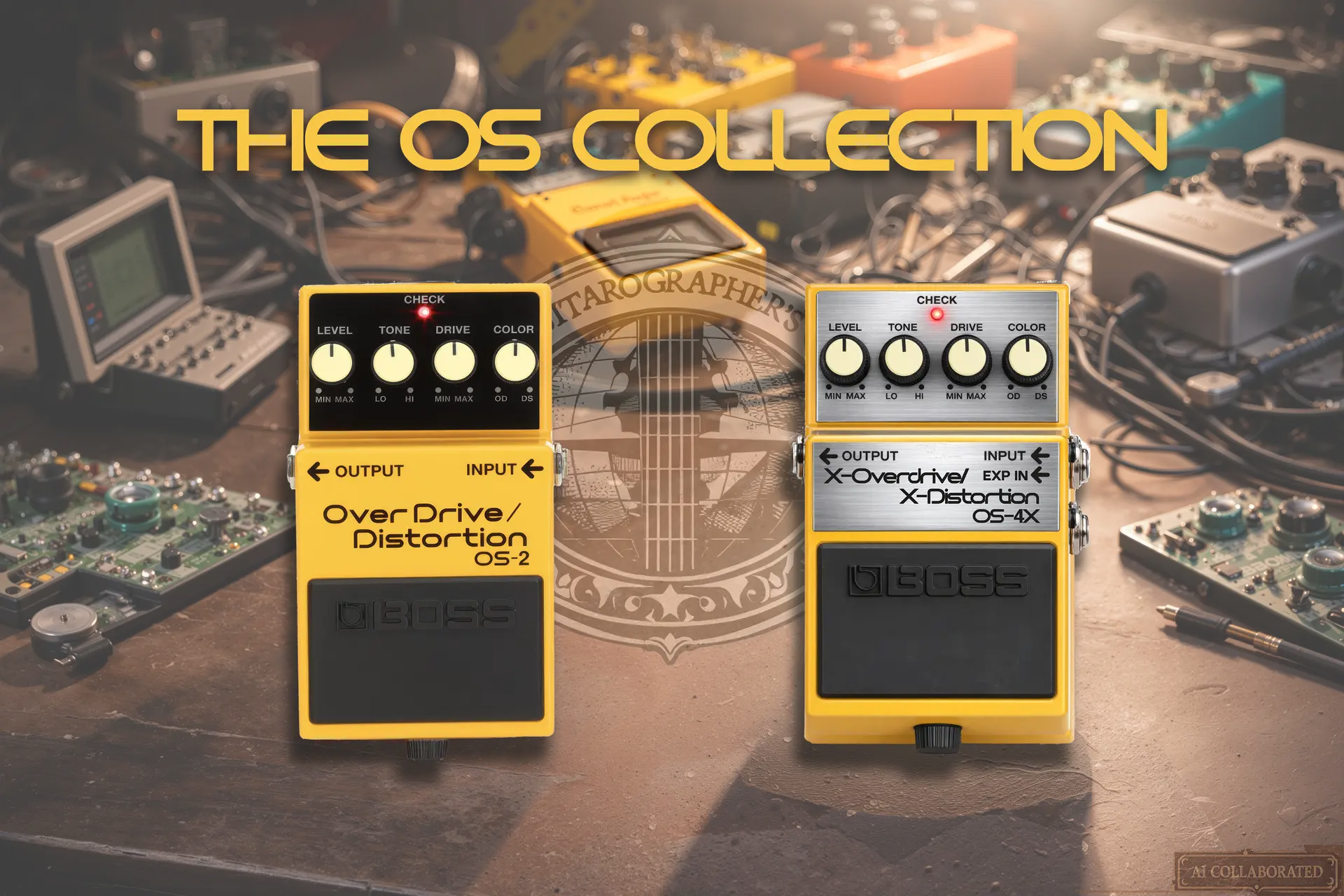
Meet the BOSS OS-2 Overdrive/Distortion Pedal
Released in mid-1990, the venerable OS-2 is an incredibly clever pedal concept and execution. Designed to give the user an SD-1 overdrive and a DS-1 distortion running in parallel, the ‘Color’ knob allows the user to mix between them.
Turn the Color knob fully CCW, you have just the SD-1. Fully CW, the DS-1. And then one can blend the two sounds as they’d like anywhere in between.

Past that, the rest is your bog standard layout. ‘Level’ for your output, ‘Tone’ and ‘Drive’ to taste.
It’s difficult to be overly critical of the pedal as the current state of the world for which it was designed was very different compared to today.
The SD-1 and DS-1 themselves were already ‘seasoned veterans’ by 1990. The DS-1 having come out of 1978, and the SD-1 out of 1981.
They were built for a world that was still ruled by tube amps, and were designed to push usually already crunchy (or edge of crunch) amps into further saturation. Each also had very distinct characters . Both were already ‘voiced’
The SD-1 for example comes out of the box:
- Mid-forward
- Compressed
- Softened low end
- Pushed upper mids
A VERY different profile from what modern guitarists are used to, where a distinct lack of color and compression tends to be preferred – which has led to the rise of the ‘transparent overdrive’.
And of course the DS-1 needs no introduction. It will kick the door down, kiss your significant other, take your dog, and grab the rest of your beer on its way back out the door. It’s got all the beefy chug that made it a staple throughout not just the 80’s, but the 90’s and beyond. The main point is: It wasn’t built for ‘subtle’. It was built to help already stressed tube amps belch fire and brimstone.
Fast Forward to Today
In today’s guitar ecosystem, the OS-2 can struggle as much as the SD-1, and to a lesser degree the DS-1, can.
Tube amps are no long the standard. Modelers and profiles have quickly claimed the majority of rigs everywhere. IEMs, silent stages, and bedroom/basement/home studios through headphones or studio monitors are the more common use cases.
Many modern rigs are built around mostly clean amps (or clean amp models/profiles) with high headroom, to allow the majority of the dirt to come from single or stacked dirt pedals.
It’s not that the OS-2 (or the SD-1 or DS-1) are bad pedals or obsolete in anyway. They were just designed for a very different stage.
Each has a well defined lane it wants to stay within.
- SD-1: Focused, compressed, mid-biased
- DS-1: Grainy, edgy, sometimes a little papery or scooped depending on the rig
This ended up being one of my main takeaways from this project. We’ll come back to this.

Recreating the OS-2 in the GX-10

Reading about the OS-2, I loved the idea of it. Especially as only having come to the guitar in the last few years, I didn’t have any history with the majority of BOSS’ iconic pedals.
Taking advantage of the GX series’ support for parallel signal chains, I decided to try and recreate a version of the OS-2, with the idea to use the EXP 1 pedal as my ‘Color’ knob so I could modulate between the SD-1 and DS-1 ‘sides’ while playing.
It went terribly at first.

Given I was shooting for a ‘vintage BOSS’ sound, I opted for a Fender Twin model through a 1×12″.
Sensible enough.
Where I erred – and what took me hours to unlock – was that I’d approached things with a more modern mentality. I set the amp to a Low gain profile, and turned down the Gain knob.
The SD-1? Sounded awful. Thin, dull, and blunt. The old ‘blanket over the amp’ trick.
I was baffled. But after spending sometime attending Google U. to explore what makes the SD-1 actually sound good. I discovered what I mentioned above. The SD-1? Wants a crunchy amp. It wants to push something, not carry the entire load itself – which it wasn’t built to do to begin with.
Switching the amp to a Medium gain profile and increasing the Gain knob a tick? Everything suddenly started to snap together. The sound started becoming not just usable, but musical.
The DS-1 was more forgiving, but it too seemed to better come home with the higher gain settings on the amp.
Building a System, Not Independent Sounds
The next step was the more difficult. I dialed in the SD-1 so it was just on the edge of breakup if I dug in. The DS-1 was all roar and chug.
The challenge was balancing the SD-1 and DS-1 against one another so each retained its unique voice, sounded good in isolation, but most importantly – blended well for a range of useful and interesting sounds.
This is how I did it:

That poor EXP 1 is doing a lot of work, yep. But it made itself critical to making the two sounds work well both independently and together.
As with most things EQ related, a little goes a LONG way. But I realized that trying to tame the SD-1’s mid-heavy voice, while also trying to tame the DS-1’s fizz, with a single fire-and-forget EQ configuration was an impossibility.
The Parametric EQ – in this particular case – was too limiting as I needed to reshape the entire EQ curve on-the-fly.
Enter the Graphic EQ. It ended up being the perfect tool for the job, and allowed me to create an adaptive EQ curve that was able to dynamically shape itself to the EXP 1’s pedal sweep as it blended the SD-1 and DS-1.
The end result was a patch that sounded ‘vintage BOSS’, but that I could make music with happily. Very happy with it.
OS-4X: The Next Generation

Then I got to wondering if I could create an updated version of the OS-2 that was an updated version of it in every way, using modern components, but without losing the core design concept of blending between an OD and a distortion.
I came up with the OS-4X. Which doesn’t actually exist outside of this patch. But I kinda’ dig how the concept came together.
It would be cool to have dual concentric knobs for Tone and Drive, a knob for each ‘half’. But fortunately that’s not a constraint I have to worry about in the GX-10.
The idea’s yours if you want it BOSS, with all my blessings.

I immediately swapped in the modern variants of the respective components.
- The SD-1 -> the MDP-powered X-Overdrive
- The DS-1 -> the MDP-powered X-Distortion
- the Fender Twin -> the custom BOSS ‘Boutique’ amp model (still through a 1×12″)
- The Analog Chorus -> A ‘custom recipe’ Chorus built on a Pitch-Shifter platform
- Analog Delay -> Rack style digital delay
- Spring Reverb -> Small Hall Reverb
The design goal was to take the entire concept of my OS-2 recreation forward into this second quarter of the 21st century. I wanted an explicit contrast between the OS-2 and OS-4X patches. And I wanted each to have clear, identifiable vintage vs. modern voicing.
Starting with an already crunchy Boutique amp saved me many initial headaches. But to make the OD and Dist play well together, I needed to take a similar approach as I did with the OS-2 patch. An adaptive EQ curve, shaped to the particular voices of the X-OD, X-Dist, and Boutique amp model.

Did I Post a ‘W’?
100% absolutely.
I ended up with two distinct patches with a shared lineage, but entirely different – but musical – personalities. A/B’ing between the patches, the best I can describe what they sounded and felt like to me?
OS -2: Pre-2000’s dirt flavors. I can go from a just a hair over clean to full-on beefy chug and everything in between.
OS-4X: Post-2000’s dirt. More balanced across the spectrum, less color contributed from the OD and Dist themselves leaving the amp to better own shaping the overall voice, and a distinctly less feral, more polished feel.
Also my Pitch-Shifter-Now-It’s-A-Chrous? Sounds magnificent. Huge and lush with out cannibalizing either the fundamentals or the resonant pitches and tones. Probably not for Chorus purists. But I dig it.
…And All I Got Was This Valuable Lesson
Not every pedal is meant to be a self-contained, chain-agnostic “good sound generator.” Some are meant to be specialists inside a larger system.
And when you give them the system they expect, they stop sounding flawed and start sounding purposeful.
That’s especially true with a lot of BOSS gear. Especially early BOSS gear.
The design logic often feels like:
- This effect has a role
- This role assumes a specific context
- In the right context, it works beautifully
- Outside that context, people may blame the pedal for not being something it was never trying to be, or meant to be
That old axiom: “Professionals don’t blame their tools”, held true here.
The SD-1 and DS-1 don’t need to be, and shouldn’t be, castigated for wanting to stay in their lanes. For them to shine, they just need to be used in the lanes they were engineered for.
People can be a lot like this too. But that’s a topic for a future blog post.
Until next time, sonic explorers!
